
A Journey of a Lifetime
Hajj and Umrah Guide
The pilgrimage to Masjid Al-Haram in Makkah and Masjid Al-Nabawi in Madinah is a profound spiritual experience for Muslims worldwide. Whether performing Hajj, the obligatory pilgrimage, or Umrah, the voluntary pilgrimage, both journeys offer immense rewards and a deep connection to faith.
Umrah: A Sacred Journey of Devotion
Umrah is a pilgrimage that can be performed at any time of the year. Here are its key steps:
1. Ihram – Before Reaching Meeqat
✔ Remove unwanted hair, trim nails, and perform ghusl (bath) or wudhu (ablution).
✔ Wear Ihram clothing—two unstitched white cloths for men and modest attire for women (without covering the face).
✔ Declare Niyyah (intention) for Umrah: LabbaikAllahumma bi-`Umrah (Here I am, O Allah, making Umrah).
✔ Recite Talbiyah: Labbayk Allahumma Labbayk, Labbayk la sharika laka Labbayk. Innal hamda wanni‘mata laka walmulk, la sharika lak. (Here I am, O Allah. You have no partner. All praise, grace, and sovereignty belong to You.)
2. Tawaf
✔ Enter Masjid Al-Haram, stepping in with the right foot while reciting: Allahumma aftah lee abwaaba rahmatika (O Allah, open the doors of Your mercy for me.)
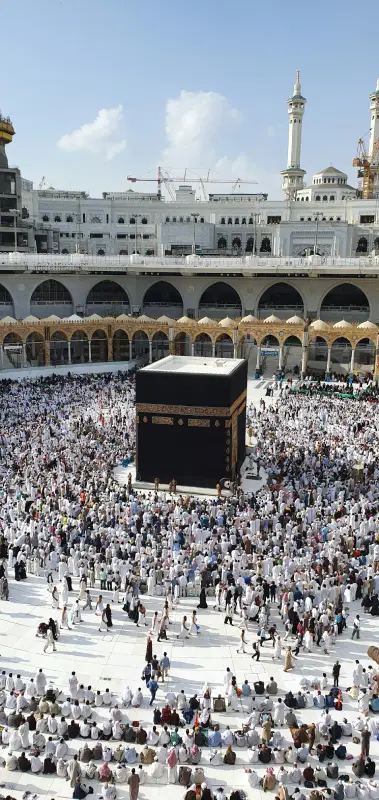
✔ Perform Tawaf, circling the Ka'bah, beginning at Al-Hajarul-Aswad (Black Stone) and reciting Allahu Akbar.
✔ Men should walk briskly during the first three rounds (Raml) and normally for the remaining four - total of 7 times.
✔ Between Ar-Ruknul-Yamani and Black Stone, recite: Rabbanaa aatinaa fid-dunyaa hasanatan wa feel aakhirati hasanatan wa qinaa 'adhaaban naar. (O our Lord! Grant us good in this world and in the Hereafter, and protect us from the torment of Hell.)
✔ After Tawaf, offer two raka’at behind Maqam Ibrahim and drink Zamzam water.
3. Sa’ee
✔ Begin at Safa, reciting: Innas-safaa wal marwata min sha'aa'irillaahi. (Quran)
✔ Walk from Safa to Marwah, completing seven rounds while supplicating.
✔ Men should run between the two green lights.
4. Halaq Shaving/Trimming Hair
✔ Men: Preferably shave the entire head or trim evenly.
✔ Women: Trim one-third of a finger length.
✔ Ihram restrictions are now lifted, marking the completion of Umrah.
لَبَّيْكَ اللَّهُمَّ لَبَّيْكَ لَبَّيْكَ لاَ شَرِيكَ لَكَ لَبَّيْكَ إِنَّ الْحَمْدَ وَالنِّعْمَةَ لَكَ وَالْمُلْكَ لاَ شَرِيكَ لَكَ
I respond to Your call O Allah, I respond to Your call, and I am obedient to Your orders, You have no partner, I respond to Your call All the praises and blessings are for You, All the sovereignty is for You, And You have no partners with you. (Bukhari)
Hajj: The Ultimate Pilgrimage
Hajj occurs annually during Dhul-Hijjah and consists of multiple stages.
Step-by-Step Hajj Route
8th Dhul-Hijjah (Yawmut-Tarwiyah) – Mina (City of Tents)
✔ Taking bath before assuming Ihram & putting scent on body before wearing is Sunnah.
✔ Enter Ihram (Fard) and declare intention for Hajj: Labbaik Allahumma bi-Hajjah (Here I am, O Allah, making Hajj).
✔ Performing Tawaf al-Qudum when a pilgrim arrives in Makkah is Sunnah.
✔ Sa’ee involves walking between Safa and Marwah, which is Wajib.
✔ Travel to Mina after Fajr and spend the day in prayer. Spending the day and the nights of Tashriq at Mina is Sunnah.
9th Dhul-Hijjah (Yawmu ‘Arafah) – Arafah
✔ Travel to Arafah, where pilgrims engage in deep supplication and listen to the Khutbah.
✔ Recite the best supplication for the day:
لاَ إِلَهَ إِلاَّ اللَّهُ وَحْدَهُ لاَ شَرِيكَ لَهُ لَهُ الْمُلْكُ وَلَهُ الْحَمْدُ يُحْيِي وَيُمِيتُ وَهُوَ حَىٌّ لاَ يَمُوتُ بِيَدِهِ الْخَيْرُ كُلُّهُ وَهُوَ عَلَى كُلِّ شَىْءٍ قَدِيرٌ
None has the right to be worshipped but Allah alone, with no partner, to Him belongs all sovereignty and to Him is the praise, He gives life and gives death, and He is Ever-Living and does not die; in His Hand is all goodness and He is Able to do all things.
✔ Perform Wuquf at Arafah (Fard), seeking forgiveness until sunset.
Night of 9th Dhul-Hijjah – Muzdalifah
✔ Travel to Muzdalifah after sunset, pray Maghrib & Isha, and rest under the open sky.
✔ Perform Wuquf at Muzdalifah is Wajib.
✔ Collect 70 pebbles for stoning.
10th Dhul-Hijjah (Yawmun-Nahr) – Stoning & Sacrifice
✔ Travel to Mina, performing Rami, which is stoning the pillar at Jamaratul-Aqabah (Wajib).
✔ Offering Udhiya (sacrifice) is Wajib.
✔ Shave/trim hair (Wajib), marking the end of Ihram restrictions.
✔ Travel to Makkah to perform Tawaaful-Ziyarah on the 10th is Fard, but can be done until the 13th of Dhul-Hijjaj.
✔ Spending the Eid night in Muzdalifah is Sunnah.
11th-13th Dhul-Hijjah – Stoning in Mina
✔ Continue stoning the three Jamarat each day.
✔ Performing Tawaaful-Wadaa (Farewell Tawaf) before leaving Makkah is Wajib.
Categories of Worship in Islam
| Description | Impact of Missing It | Examples |
|---|---|---|
| Fard (Obligatory) |
| Salah (Prayers), Sawm (Fasting) |
| Wajib (Necessary) |
| Witr Prayer, Udhiyah (Sacrifice) |
| Sunnah (Recommended) |
| Extra prayers, acts of kindness |
It is important to note that some scholars consider Fard and Wajib as two faces to the same coin.
Types of Hajj
There are three types of Hajj, each differing in how Umrah is incorporated into the pilgrimage:
| Type of Hajj | Includes Umrah? | Requires Sacrifice? | Ihram Exit Before Hajj? |
|---|---|---|---|
| Tamattu' | Yes, before Hajj | Yes | Yes |
| Qiran | Yes, with Hajj | Yes | No |
| Ifrad | No | No | No |
The Virtues of Dhul Hijjah: A Time of Spiritual Elevation
Imagine a time so sacred that every moment holds the potential for immense spiritual reward. The first ten days of Zul Hijjah (Dhul Hijjah) are precisely that—a period of unparalleled virtue in the Islamic calendar. Whether you are preparing for Hajj, engaging in extra worship, or simply seeking closeness to Allah, these days offer a golden opportunity to elevate your faith. The Prophet Muhammad (peace be upon him) emphasised their significance, stating:
قال رسول الله (ﷺ): " ما من أيام العمل الصالح فيها أحب إلى الله من هذه الأيام" يعني أيام العشر
The Prophet Muhammad (peace be upon him) emphasised their significance, stating: "There are no days in which righteous deeds are more beloved to Allah than these ten days." (Bukhari)
The Magnificence of the First Ten Days
The first ten days of Zul Hijjah are considered the most blessed days of the year. Allah swears an oath by them in the Qur’an:
وَالْفَجْرِ. وَلَيَالٍ عَشْرٍ
"By the dawn; by the ten nights." (Quran)
Scholars, affirm that these verses refer to the first ten days of Zul Hijjah. During this time, believers are encouraged to increase their acts of worship, including prayer, fasting, charity, and remembrance of Allah.
Fasting on the Day of Arafah
One of the most significant days within Zul Hijjah is the Day of Arafah (9th Zul Hijjah). The Prophet (peace be upon him) said: "Fasting on the Day of Arafah expiates the sins of the previous year and the coming year." (Muslim)
For those not performing Hajj, fasting on this day is a powerful means of seeking forgiveness and spiritual renewal.
The Power of Dhikr and Takbeer
During Zul Hijjah, believers are encouraged to engage in dhikr (remembrance of Allah). The Takbeeraat of Tashreeq, recited after every obligatory prayer from the 9th to the 13th of Zul Hijjah, is a beautiful way to glorify Allah:
اللَّهُ أَكْبَرُ اللَّهُ أَكْبَرُ لَا إلَهَ إلَّا اللَّهُ وَاَللَّهُ أَكْبَرُ اللَّهُ أَكْبَرُ وَلِلَّهِ الْحَمْدُ
"Allah is the Greatest, Allah is the Greatest. There is no deity besides Allah and Allah is the Greatest. Allah is the Greatest and all praises belong to Him Alone."
The Reward of Qurbani (Sacrifice)
Eid ul-Adha is the day when Muslims worldwide perform Qurbani. The act of Qurbani (sacrifice) during Zul Hijjah commemorates the devotion of Prophet Ibrahim (peace be upon him). The Prophet Muhammad (peace be upon him) said: "For every hair of the sacrificial animal, there is a reward." (Ibn Majah)
This practice not only fulfils a religious obligation but also strengthens the bond of compassion and generosity within the Muslim community
Visiting Madinah – Masjid Al-Nabawi & Masjid Quba
Although visiting Madinah is not obligatory for Hajj or Umrah, it is highly recommended.
✔ Masjid Al-Nabawi – The second-holiest mosque in Islam, offering unparalleled blessings.
✔ Masjid Quba – The first mosque built in Islam, where prayers hold the reward of an Umrah.
The Prophet Muhammad (PBUH) said: "One prayer in my mosque (Madinah) is better than 1,000 prayers elsewhere, except Masjid Al-Haram (Makkah). And one prayer in Masjid Al-Haram is better than 100,000 prayers in any other mosque."
✔ Mina – The tent city where pilgrims stay.
✔ Muzdalifah – The site for collecting pebbles.
✔ Arafah – The most spiritually significant location in Hajj.
Hajj & Eid Ul-Adha: Profound Lessons for Muslims
The sacred journeys of Hajj and the joyous observance of Eid al-Adha offer profound lessons for Muslims worldwide. These spiritual pillars instil timeless values that resonate far beyond the pilgrimage itself.
Unity and Equality: The Hajj remarkably unites Muslims from every corner of the globe. It serves as a powerful reminder that before Allah, all are truly equal, transcending differences in social status, race, or nationality. This profound display of Islamic unity underscores the universal brotherhood within the faith.
Sacrifice and Devotion: Both Hajj and Eid al-Adha emphasize the importance of sacrifice, directly mirroring the unwavering devotion of Prophet Ibrahim (peace be upon him). These experiences teach that genuine faith often necessitates prioritizing spiritual commitments above personal comfort and worldly desires. The act of Qurbani during Eid embodies this deep spiritual surrender.
Humility and Gratitude: Navigating the physical and emotional challenges inherent in Hajj fosters a deep sense of humility. Concurrently, the celebration of Eid al-Adha powerfully reinforces an abiding gratitude for Allah's abundant blessings. It’s a time for reflection on one's fortune and purpose.
Renewal of Faith: The transformative experience of Hajj deeply encourages self-reflection and a renewed, vibrant commitment to one's spiritual path. Pilgrims are urged to integrate these invaluable lessons from Hajj into their daily lives, strengthening their connection to Islamic teachings.
Final Thoughts: A Life-Changing Experience
Hajj and Umrah are profound journeys that cleanse the soul and bring Muslims closer to Allah. Every step taken in Masjid Al-Haram and Masjid Al-Nabawi carries immense blessings, shaping a pilgrim’s faith and devotion.
As pilgrims complete their sacred rites, Eid ul-Adha serves as a powerful reminder of sacrifice, obedience, and gratitude. Whether performing Hajj or celebrating at home, this occasion reinforces the values of faith, unity, and charity.
May Allah (SWT) accept your pilgrimage and grant you Hajj Mabroor (an accepted Hajj). May this journey inspire lifelong devotion and spiritual growth. Are you ready to embark on this journey of a lifetime? Share your thoughts and experiences below!
May Allah (SWT) accept your pilgrimage and grant you Hajj Mabroor (an accepted Hajj).